

Retractable screens
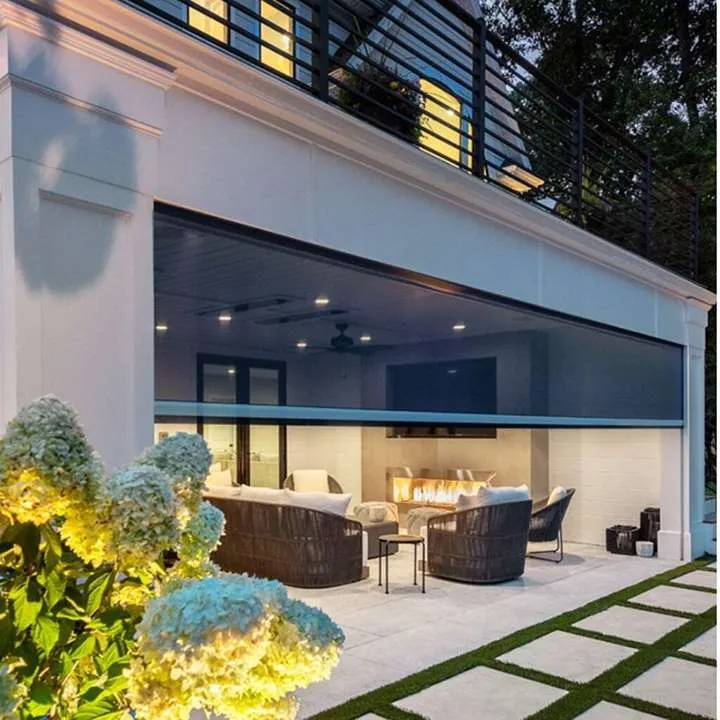
Draw the mesh over for the evening, then send it back into a narrow cassette and the sea view opens up again. The go-to for villa terrace doors and tower balconies. More on retractable fly screens.
Throw the terrace doors open to the sea breeze, let the air move through the villa, and keep mosquitoes and flies on the other side of the mesh. Our custom screens go up all over the island, on the frond villas, the sea-facing towers down the trunk, and the resort-side homes on the crescent.
 Made to measure · No drilling
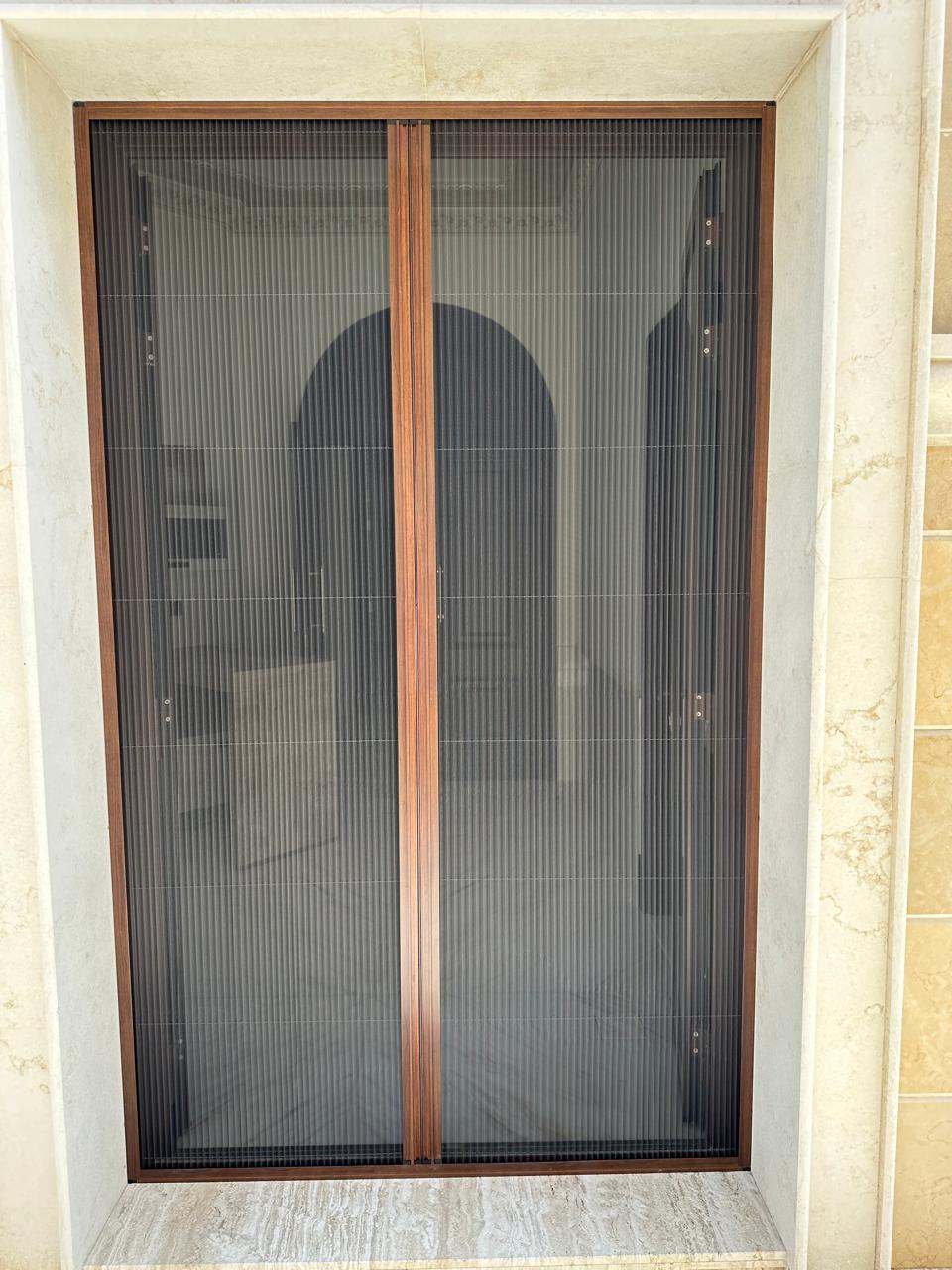
See the mesh in place on a Palm terrace door, a tower balcony and a wall of glass. Tap a clip to play it.
From the broad terrace runs of a frond villa to the tall, sea-facing glass of a trunk tower, the openings here vary a lot. Below are the screen styles we put in most often on the Palm.
Draw the mesh over for the evening, then send it back into a narrow cassette and the sea view opens up again. The go-to for villa terrace doors and tower balconies. More on retractable fly screens.
Set on its own runner next to a sliding terrace or balcony door, this one travels as lightly as the glass it sits beside. See sliding door fly screens.
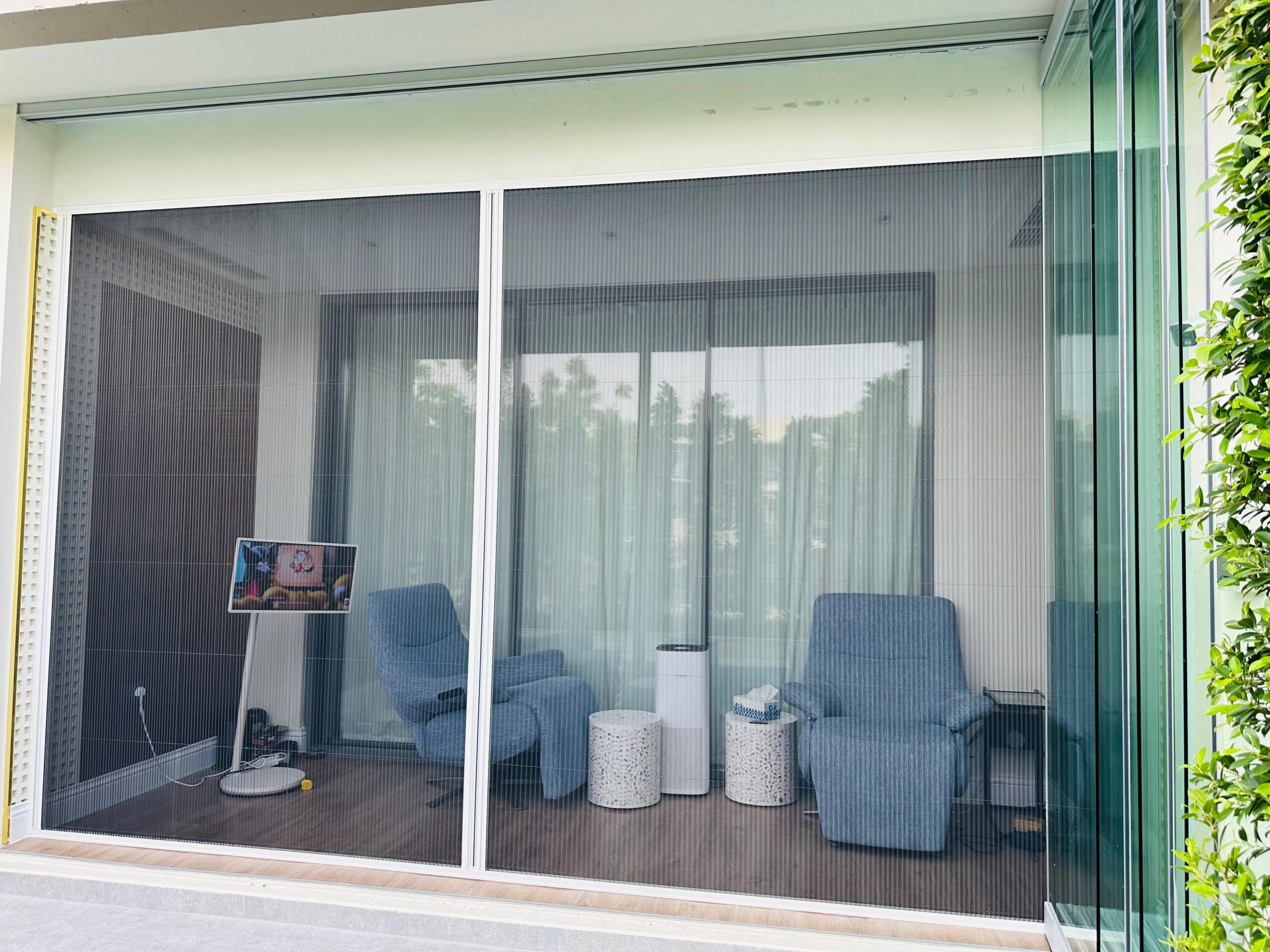
Here the mesh gathers to one side in soft folds, handling the very wide glass spans of a Palm villa far more gracefully than one long sliding panel. See pleated fly screens.
A pair of mesh halves that close themselves along a magnetic seam, leaving nothing to step over. Useful on a kitchen or side door off the terrace. More on magnetic fly screens.
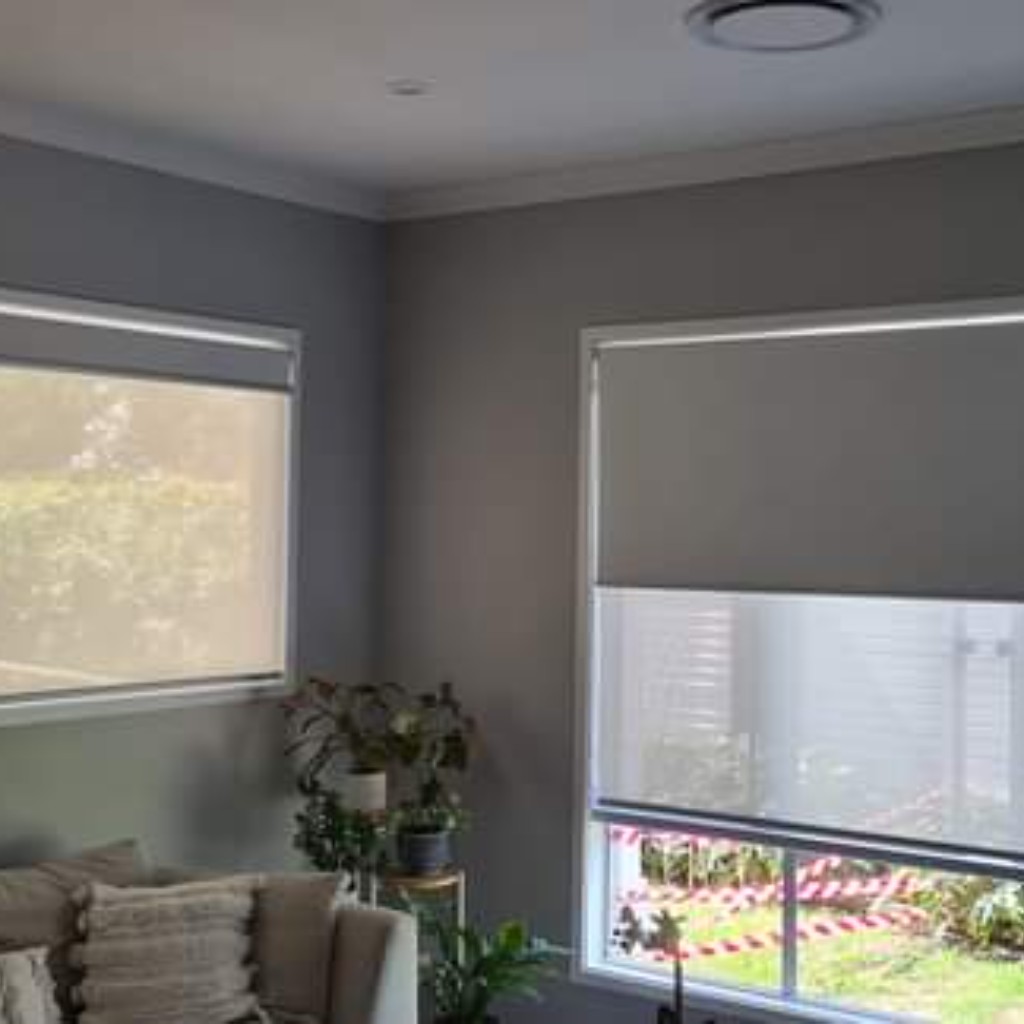
Made-to-frame screens, fixed or opening, for the sea-facing bedroom and living-room windows, so the outlook stays clear. See fly screens for windows.
Screens for villa entrances and beach-access doors, cut to the opening and bonded on without leaving a mark on the finish. More on fly screens for doors.
The Palm is laid out as a trunk of towers, sixteen fronds of villas and a sheltering crescent. Here is where screens earn their keep across those homes.
Frond villas open onto the terrace and pool through a wide run of sliding glass. A sliding or retractable screen lets you live with those doors open in the cool of the evening while insects stay out. Related sliding door fly screens.
Almost every trunk apartment, from Shoreline to the Golden Mile, has a balcony over the water. A screen on that door keeps it open to the breeze without the mosquitoes that lift off the planting at dusk.
Palm living rooms are built around tall glass. We make pleated or panel screens to span those openings so you can ventilate the whole room without losing the light or the look. See pleated screens.
Many fronds run straight down to a private stretch of sand. The door you use to reach it takes a screen that closes itself, so sandy feet and an open door do not mean a kitchen full of flies.
A sea-facing bedroom you open at night wants a screen that disappears against the water. An openable window screen in a dark mesh does that and keeps the night air moving. See window fly screens.
Out of sight, the kitchen window, the utility door and the staff entrance are quick to sort. A fixed or magnetic screen keeps the working part of the house insect-free right through the season.
A beachfront address is wonderful to live in and tough on poor materials. We build and fit screens with that in mind, and we know the towers and the fronds well.
Powder-coated aluminium and rust-free mesh stand up to the salt-laden air and humidity that quickly mark thin, untreated screens so close to the water.
Palm homes carry premium frames and stonework, so we hold every screen on tape rather than drilling. Nothing is bored into the glazing or the marble.
Slim frames and a fine, dark, see-through mesh keep the sea and sky in front of you. The screen does its job without getting in the way of the outlook.
Most firms stock a single mechanism. We run three different supplier lines at once, so a door can be paired with the right gear at the right price.
Our visit is free and commits you to nothing. We size up each opening, lay mesh samples against your daylight, and give a plain price ahead of any order.
A torn or jamming screen anywhere on the island can be mended and re-meshed by us, even ones another company fitted. More on fly screen repair.
Because each screen is cut to size, the price tracks the opening and the system chosen. The figures below are fair starting points for Palm homes, shown before the five percent VAT.
Size and system move the price, so a broad terrace span lands at the top of the range and a lone window near the bottom. The complete quote comes at the free measure and nothing is added afterwards. Pay by cash or online.
One straightforward routine, the same for a sprawling frond villa or a compact trunk apartment.
Message your tower or villa number over WhatsApp, choose a slot, and we come to you. On site we take every measurement and walk you through the best screen and mesh for the job. Free, and no pressure to commit.
We build each screen to your exact sizes in the system and mesh shade you picked, with the frame coated to cope with the shoreline. Reckon on four to eight working days for this.
We return and bond each screen on with heavy-duty tape, about fifteen minutes for a standard opening and a touch more for a long terrace run. Nothing drilled, nothing left behind.
The Palm is one of the Dubai addresses we enjoy most, and our work reaches across the city and the wider UAE. Close by we screen homes in Dubai Hills and over at JVC; the whole map sits on our services page.
A handful of the screens we have built and installed for island villas and apartments.
The thing that makes the Palm special, life right on the water, is also the thing that decides how a screen should be built. Salt sits in the air every day out here, and over a season or two it eats into thin, untreated metal and rusts cheap fixings until a screen sticks, stains or sheds its mesh. A frame finished in a proper powder coat, paired with a mesh that does not corrode, simply shrugs that off. It is the single biggest reason we steer Palm homes towards quality rather than the cheapest option, and it is money that shows its worth a few summers down the line.
The way people live here matters too. A Palm home is built to open up, with terrace doors folded back, the pool a step away and dinner outside as the heat drops. That is exactly when the mosquitoes arrive, carried in on the same evening breeze you opened the doors to enjoy. A screen lets the air and the sound of the water in and keeps the insects out, so the doors can stay open well past sunset. On the fronds that usually means a long sliding or pleated screen across the terrace; in the towers it is the balcony slider and the windows that frame the view.
And the view is the point of the whole island, so a screen here has to stay out of the way of it. We keep frames slim and let you choose a darker mesh that reads as almost nothing against the bright sea and sky, so you notice the water and not the screen. Nothing is drilled into the expensive glazing or the stone, the fit is clean, and if you ever sell or restyle, the screens lift away without leaving a trace. Tell us the tower or the frond and we will bring the right samples to your door.
Down-to-earth pointers for island villas and apartments, from coping with the salt air to protecting your view.
The two Palm home types lead in slightly different directions. A frond villa is mostly about width, with long sliding runs onto the terrace and pool deck, so a sliding or pleated screen that spans the opening earns its place, backed up by window screens through the bedrooms. A trunk apartment is more compact: a balcony slider facing the sea and a handful of windows, well covered by a retractable balcony screen and made-to-size window screens. Either way, let how often you use each opening guide the choice, favouring screens that open where you regularly step through.
This is the part that separates a screen that lasts on the Palm from one that does not. The marine air carries fine salt that settles on everything near the shore, and on bare or thinly finished aluminium it works its way in, dulling the metal, seizing rollers and rotting low-grade mesh. A frame protected by a full powder coat resists that, and a fibreglass or quality polyester mesh will not rust the way a metal mesh can. It is why we are upfront that the island is not the place to cut corners on materials. Spending a little more on the coating and the mesh is what keeps a screen sliding sweetly years after a bargain one has stained and stuck.
You bought the Palm for the water, so the screen must not get in the way of it. Two things keep it discreet. The first is the mesh shade: a charcoal or dark-grey weave drinks the light and reads as almost invisible from inside, where a pale mesh shows up as a bright grid across your outlook. The second is the frame, kept slim and finished close to the colour of your glazing so the eye slides past it. Put those together and you get full protection with a view that still looks like an open door. We bring samples to the measure so you can judge them against your own horizon.
The big sliding runs that make Palm villas feel open are the most satisfying openings to screen and the ones that most reward getting right. For a wide span a single sliding panel can mean a long pull, so a pleated screen that gathers to one side, or a pair of panels meeting in the middle, often handles it more gracefully. The track is set so the screen glides with a finger, and the mesh is tensioned to take the sea breeze without billowing. We measure the full run and design the screen to the opening rather than forcing a standard size onto it.
Screens do not all use the same running gear, and beside the sea the sensible pick tilts towards the tougher options. Our three supplier lines, drawn from German, Italian and Turkish makers, give us room to fit the mechanism to the task. A terrace door in daily use calls for a sturdy, smooth runner that fends off corrosion; a quiet guest-room window is happy with something lighter. At the visit we lay out the workable choices opening by opening, each carrying its own price, and we will gladly say why one line copes with salt air better than another, so your call is a well-informed one.
A screen here needs only light attention to stay sweet. Rinsing the mesh with fresh water now and then washes off the salt film that gathers near the shore, and running a cloth along the track keeps the glide smooth. Should something wear, a stiff roller, slack mesh, a panel off its run, it can usually be put right, and we re-mesh and refit makes of every sort, not just our own. A quick photo of yours is enough for us to say what is needed. More on our repair service and mesh replacement.
Plenty of Palm villas live as much outside as in, with a pergola over the dining table, a shaded terrace beside the pool, or a garden majlis set up for evening guests. Those outdoor rooms are a joy until the mosquitoes arrive with the dusk, and they can be screened as well. Where there is a solid frame or a built structure we run mesh panels around the open sides, and where a villa meets the garden through tall doors a sliding or pleated screen turns the threshold into a line insects will not cross. The netting keeps its see-through quality, so the garden and the water still feel part of the space. Describe how the area is built and we will suggest a way to enclose it that keeps the look you wanted.
Putting screens on a home is part comfort, part health. The World Health Organization counts window and door screens among the plain, effective ways to hold off the mosquitoes that spread disease. Out on the Palm, with water on every side and planted grounds that pull insects in once the weather warms, a screen lets you welcome the sea air while leaving the bugs outside. It follows the same logic as guarding against illnesses like dengue, where keeping mosquito bites down at home is a sound daily habit.
The things Palm Jumeirah residents put to us most often when they are weighing up a free measure.
Yes. We cover the whole island, the apartment towers along the trunk, the villas out on the fronds, and the homes around the crescent. Much of our Palm work is large frond villas with sliding terrace doors and sea-facing balconies on the Golden Mile and Shoreline. Tell us your building or villa number and we will visit to measure at no cost, with no pressure to order afterwards.
This is the question that matters most on a beachfront island, and the answer is yes when the screens are made properly. We use powder-coated aluminium frames that resist the salt-laden air far better than the thin, untreated metal in cheaper screens, and the mesh is a marine-friendly fibreglass or polyester that does not rust. Living a few steps from the sea is hard on poor hardware, so the frame and the coating are exactly where it pays to spend.
Most frond villas open onto a terrace or pool deck through a wide run of sliding glass. That kind of door usually takes a sliding panel screen on its own track, or a retractable screen that rolls away into a slim cassette when you are not using it. Both let you throw the doors open to the sea breeze in the evening while mosquitoes stay outside, and both keep the view clear. At the visit we study the actual opening and recommend the option that fits it best.
Yes. The trunk apartments, including Shoreline, the Golden Mile and the newer towers, nearly all have a balcony facing the water. A retractable or sliding screen on that balcony door lets you keep it open for the breeze without the insects that drift in off the planting at dusk. Bedroom and living-room windows get fixed or opening screens, picked by how much you use each one.
Yes, and on the Palm that is the whole point. The mesh we fit is a fine see-through netting, and in a darker shade it almost disappears against the bright water and sky, so the view you paid for stays clear. Pairing it with a narrow frame finished near your glazing tone keeps the whole thing discreet. We carry samples along so you can hold them to your own outlook before you decide.
Yes. Palm homes are full of tall glass spans, and we make screens to fit them, up to around six metres high and twelve metres wide. For a very wide opening a pleated screen that folds away to one side, or a set of sliding panels, usually works better than one long pull. We measure the run on site and design the screen around it so it sits neatly and moves easily.
Reckon on roughly 300 dirhams for a fixed screen, about 400 for an opening window screen, and from around 700 for a door, each before the five percent VAT. Palm homes tend to have larger openings and premium systems, so a wide terrace run naturally costs more than a single window. We measure and price each opening for free first, so the whole cost is on the table before work starts, with no surprises afterwards.
Yes to both. We bond screens on with a strong double-sided tape instead of drilling, which guards the premium frames and finishes common in Palm homes and leaves no holes. We also repair and re-mesh existing screens, including ones we did not originally make, so a torn mesh or a screen off its track can be set right instead of replaced. Send a photo across and we will give you a straight read on what it needs.
Give us your tower or frond and we will set up a free home visit. A WhatsApp message with a photo gets you the fastest quote.
Pop your details in and we will come back on WhatsApp with the next step.
No obligation, free measurement, and we normally answer inside the hour during business hours.