
Buying Guides
Roll-Up Fly Screens in Dubai: Retractable, Roller or Pleated?
Five names describe screens that look identical in photographs. Here is what actually separates them, and which one belongs on your opening.
- Five names, four mechanisms — sorted in plain English
- A span rule that tells you which one fits your opening
- Real starting prices for every type, before VAT
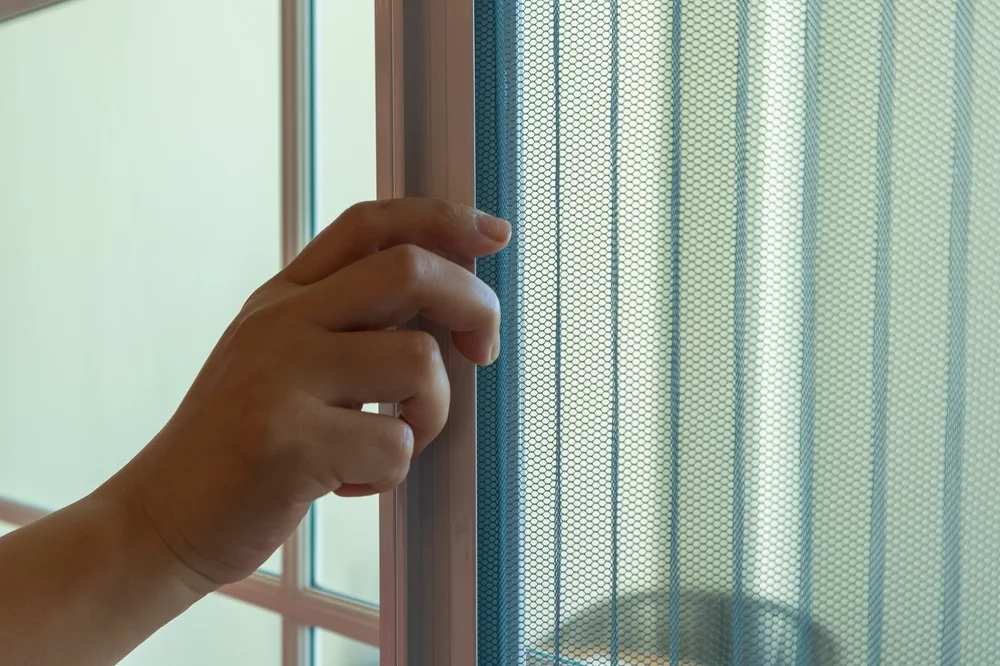
Almost every enquiry we get about a screen that "rolls away" starts the same way: someone has found four or five products that look identical in photographs, all sold under different names, and they want to know which one they are supposed to buy. Roll-up, retractable, roller, pleated, zip — in Dubai these words get used so loosely that two companies can quote you for the same opening and call it two different things. This guide sorts them out by what they actually do, so you can look at your own window or door and know which one belongs there.
Five names, one idea
Every screen in this family solves the same problem. A fixed panel of mesh is the cheapest and most reliable way to screen an opening, but it sits there permanently. On a window you rarely open that is exactly what you want. On a living-room slider you walk through forty times a day, or on a view you paid a premium for, a permanent panel is the wrong answer. So the mesh has to go somewhere when you are not using it.
That is the whole family. Where the mesh goes, and what pulls it back, is the only thing that separates them:
- Retractable — the mesh winds onto a spring-loaded roller inside a slim cassette, the same way a tape measure retracts.
- Roller — the same mechanism, but the industry tends to use this word when the screen pulls down from above rather than across from the side.
- Roll-up — not a product name at all. It is what customers call any of the above, and it is the phrase most people search for.
- Pleated — the mesh does not roll. It concertinas into folds, like a paper fan, and stacks to one side.
- Zip-track — a roller screen whose mesh edges run inside a channel, so the mesh is held under tension along both sides instead of hanging free.
- Motorised — any of the above with a tubular motor instead of a handle.
- Blind screen — a window unit with mesh on one roller and a fabric blind on another, in one housing.
So "roll-up fly screens" is a real search, but not a real category. If a supplier quotes you for "roll-up screens" without telling you whether the mesh winds, folds or zips, you do not yet know what you are buying.
The question that sorts all of them
Before mechanisms, answer this: which way does the opening want the mesh to travel, and how wide is it?
Mesh under tension behaves differently across a span than down one. A screen that works beautifully on a 90cm bathroom window will sag, bow or jam at three metres. Nearly every complaint we are called out to on a rolling screen traces back to a mechanism chosen for the look of it rather than the span.
As a rough rule, and it holds up well in Dubai homes:
- Up to about 1.2m — almost anything works. Pick on convenience and looks.
- 1.2m to roughly 2.5m — single retractable or roller is still comfortable; a pleated screen starts to feel better on a door.
- 2.5m to 4m — pleated or zip-track. A single free-hanging roller at this width will bow.
- Beyond 4m, or anywhere exposed to wind — zip-track, usually motorised. Look at extra-wide fly screens for spans most systems will not cover.
If you are not sure which of your openings is which, our guide to fly screen installation in Dubai works through the measuring side in more detail.
Retractable screens: the cassette and the spring
The mesh is wound on a sprung roller inside an aluminium cassette. You pull it across or down by a handle bar, it latches on the far side, and when you release it the spring takes the mesh back out of sight. On a window the cassette is usually 35–45mm — slim enough that people stop noticing it within a week.
Where it earns its place: openings where the view matters, or where a fixed panel would be in the way. Living-room sliders, bedroom balcony doors, kitchen windows above a counter. It is the default choice for most Dubai apartments and the one we fit most often — see retractable fly screens for the range.
What to watch: the spring is the part doing the work, and springs are tuned to a span. A cassette sized for 1m fitted to a 2m opening will either snatch the handle out of your hand or fail to retract cleanly. Ask what width the unit is rated to, not just whether it "fits".
The other thing: a retractable screen only works while it is closed. A screen pulled three-quarters of the way across is an open window. That sounds obvious; it is the single most common reason a household with screens everywhere still has mosquitoes, which we cover properly in why mosquitoes still get into your Dubai home.
Roller screens: the pull-down on a window
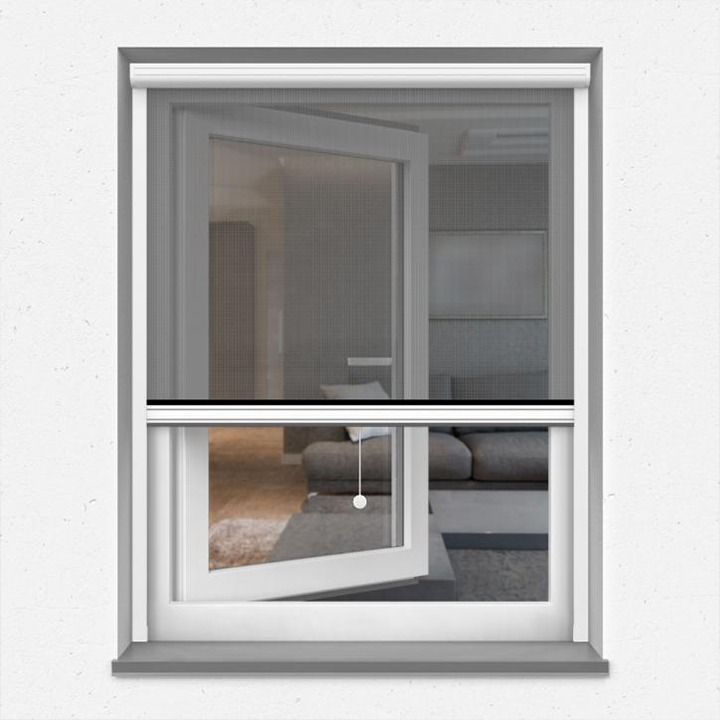
Mechanically the same spring and roller, mounted above the opening so the mesh comes down rather than across. It suits a window better than a door, because gravity is helping rather than fighting you and there is no track along the sill to collect sand.
Where it earns its place: windows you open for air rather than reach through — stairwells, upstairs bedrooms, awning and top-hung windows. It is also the friendliest option on a window with a deep sill or plants on it, because nothing has to slide past them. Roller fly screens covers the sizes.
What to watch: a free-hanging roller has nothing holding its side edges. On a breezy day the mesh lifts at the sides and the gap it leaves is more than enough for a mosquito. Below about 1.2m this is rarely a problem. Above it, or on an exposed elevation, you want the edges captured — which is what zip-track does.
Pleated screens: folding mesh for a wide door
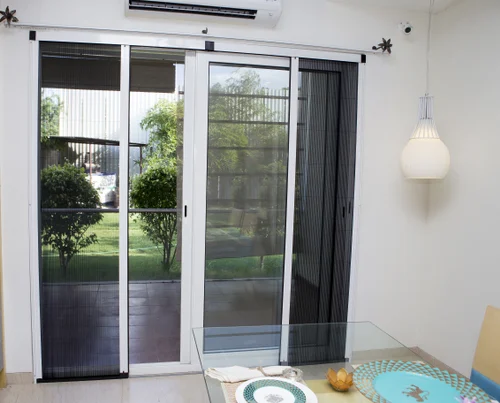
The mesh is pre-creased and folds into a concertina as it opens and closes, running on a bottom track with a cord keeping the pleats evenly spaced. Because the mesh is not under roller tension, span stops being the limiting factor — a pleated screen handles a wide patio door comfortably where a single roller would bow.
Where it earns its place: wide sliding and bi-fold doors, villa terraces, anywhere you want a screen you can stop halfway and leave there. Pleated screens hold position rather than springing back, which people with young children and pets tend to prefer. See pleated fly screens.
What to watch: the bottom track. It is low-profile but it is there, and in Dubai it will collect sand. Running a vacuum nozzle along it two or three times a year is the whole maintenance routine, and skipping it is what makes a pleated screen feel stiff after a couple of summers.
Zip-track screens: the only one that holds in wind
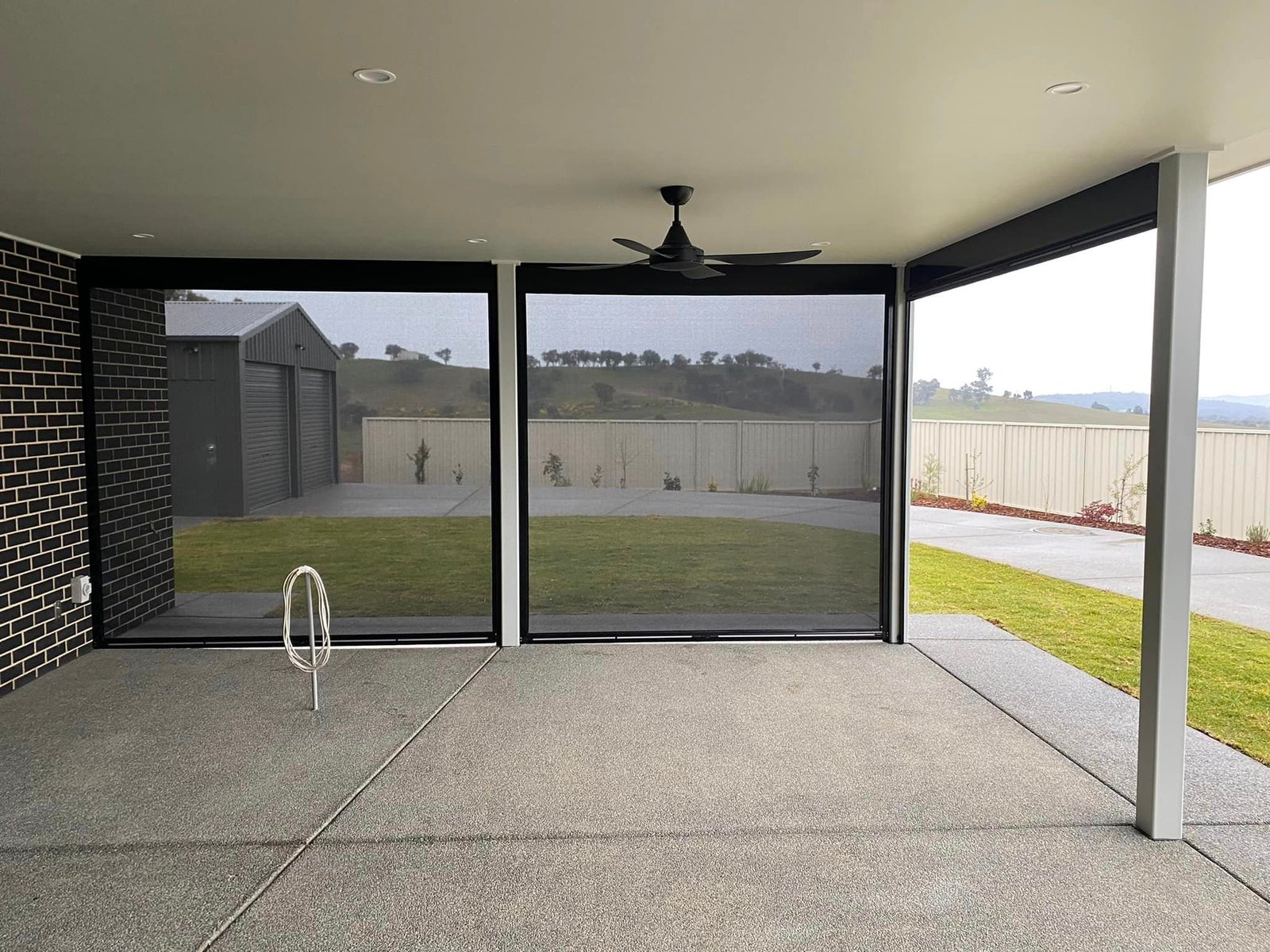
A zip screen is a roller screen with a welded edge on the mesh that runs inside a channel on each side, so the mesh cannot leave the track. The result is a panel held taut top to bottom and side to side rather than hanging.
That one change solves the two problems that make people give up on rolling screens: the mesh no longer bows in the middle of a wide opening, and it no longer lifts at the edges in wind. On a high floor in Dubai, or on an exposed terrace or pergola, this is the difference between a screen that works in October and a screen that works in all twelve months.
Where it earns its place: terraces, pergolas, balconies above the tenth floor, anywhere between a building's corners where wind funnels. Zipline fly screens is the product page; fly screens for balconies covers balcony openings specifically.
What to watch: zip systems need side channels, which means more hardware on the reveal than a plain roller. On a narrow reveal that has to be designed in, not discovered on fitting day.
Motorised screens: when the opening is too big to pull by hand
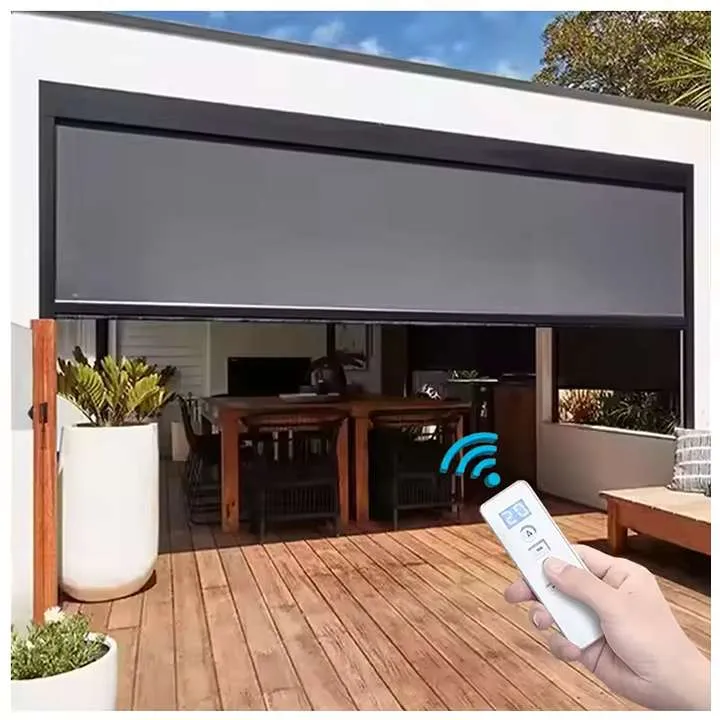
A tubular motor replaces the handle, operated by remote, wall switch or a smart-home app. The mesh and the tracks are the same; only the thing moving them changes.
Where it earns its place: two honest cases. Spans wide or tall enough that pulling by hand is genuinely awkward — think a four-metre terrace opening or a screen above a fixed sofa — and openings where a handle would be out of reach. Everything else is preference, and that is fine, but it is worth knowing you are buying convenience rather than performance. Motorised fly screens has the detail.
What to watch: power. A motorised screen needs a supply at the head of the opening, and retrofitting that into a finished apartment is sometimes the most disruptive part of the whole job. Raise it at the survey, not after.
Blind screens: the two-in-one window unit
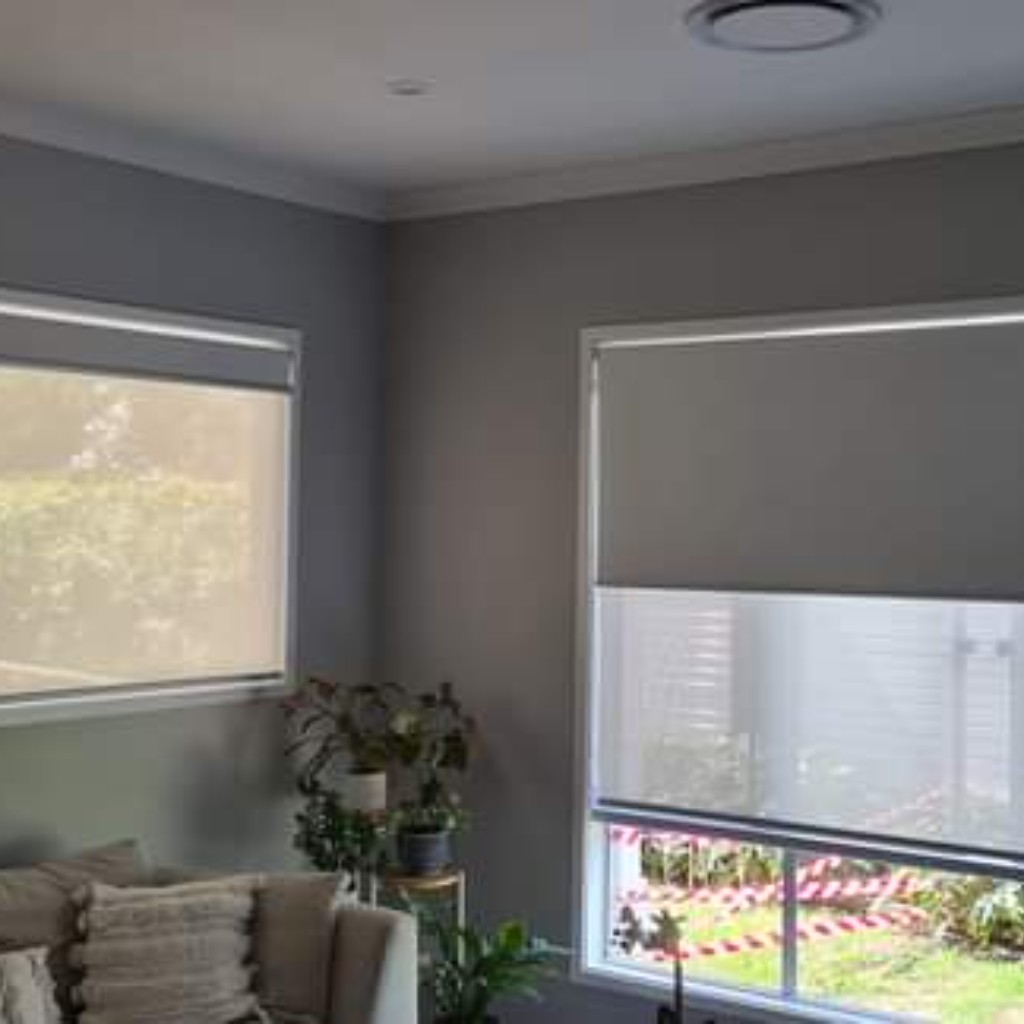
One housing, two rollers: insect mesh on one, a fabric blind on the other. You can have mesh alone for air, blind alone for shade and privacy, or both.
Where it earns its place: windows that need screening and sun control at the same time, which in Dubai is most west-facing glass. One unit, one set of fixings, one thing on the reveal instead of two. Blind fly screens covers it.
What to watch: it is the most mechanism in the smallest box of anything in this family, so it benefits more than most from being sized properly. If you only want mesh, a plain screen is cheaper and simpler — there is no prize for buying capability you will not use.
Side by side: which one suits which opening
If you read only one part of this page, read the table.
| Type | Mesh goes | Best on | Comfortable span | Holds in wind |
|---|---|---|---|---|
| Retractable | Winds into a side or head cassette | Sliders, balcony doors, most windows | Up to ~2.5m | Moderate |
| Roller | Winds up into a head box | Windows opened for air | Up to ~1.2m free-hanging | Limited |
| Pleated | Folds and stacks to one side | Wide sliding and bi-fold doors | Up to ~4m | Good |
| Zip-track | Winds up, edges held in channels | Terraces, pergolas, high floors | 4m and beyond | Excellent |
| Motorised | Any of the above, by motor | Very large or out-of-reach openings | No practical limit | As per base type |
| Blind screen | Mesh and blind on twin rollers | Windows needing shade too | Window widths | Limited |
Two openings with identical dimensions can need different answers. A second-floor bedroom window and a tenth-floor balcony door of the same width are not the same job, because one of them has wind across it.
What actually goes wrong, and on which type
After enough service calls, the failures sort themselves into a short list — and they are mechanism-specific, which is useful when you are choosing.
Retractable and roller: the spring weakens or the mesh goes slack. Almost always because the unit was undersized for the span, or because it has been released to snap back rather than walked back. Walk it. It takes two seconds and roughly triples the life of the spring.
Pleated: the bottom track clogs. Sand and fine dust settle in the channel, the pleats stop gliding, and someone forces it. Vacuum the track; do not oil it, because oil holds the dust that caused the problem.
Zip-track: the mesh edge jumps the channel. Usually after the screen has been run while something was sitting in the track, or after a genuine storm. It is a refit rather than a replacement, and it is quick.
Motorised: everything above, plus the electrics. One more thing to go wrong is the honest trade for the convenience.
All types: a tear in the mesh. A hole the size of a fingernail makes the whole screen decorative. The frame and the mechanism almost never need replacing with it — the mesh is re-tensioned into the unit you already own, which is what fly screen repair and re-mesh covers.
The mesh is not the variable
People agonise over mesh and barely think about the mechanism, when it should be the other way round. Standard insect mesh stops mosquitoes comfortably — the widely used specification is an 18 × 16 weave, with openings of roughly 1.13mm by 1.30mm and about 66% open area. A mosquito cannot pass that, and 66% open area is why a correctly specified screen does not make a room feel stuffy.
What changes the feel of a room is not the weave but the dust sitting in it. A screen that seems to have "stopped letting air through" after a Dubai summer has almost always just gone unwashed.
There are two real reasons to specify something other than standard mesh. If you are getting very small biting insects near water or heavy landscaping, those may be midges rather than mosquitoes and need a finer weave. And if you have a cat or a dog that leans on screens, a pet-grade mesh is worth the small premium — on a rolling screen especially, because a claw through a free-hanging panel is harder to patch invisibly than one in a fixed frame. Our mosquito nets page goes through the grades.
What a Dubai year does to a rolling screen
Three things here are harder on a moving screen than a fixed one, and they are worth planning around rather than discovering.
Dust. It is the main one. Fine dust works into tracks, channels and the gap the mesh rolls through. Nothing dramatic happens on day one; it is cumulative, and the screens that last are simply the ones whose tracks get vacuumed twice a year.
Sun. UV degrades cheap mesh and cheap plastic end caps long before it troubles powder-coated aluminium. On a south or west elevation this is the part of the spec worth paying for, because the mesh is the component in the sun.
Wind. The one people underestimate. A roller screen that behaves perfectly on a sheltered second floor can be unusable on the twentieth, and the fix after the fact — swapping to a zip-track system — costs considerably more than specifying it at the start. If your opening is high, exposed, or on a corner, say so at the survey.
Humidity barely matters to the hardware, though it is what drives mosquito pressure in the first place, which is why the coastal and heavily irrigated communities notice insects more than the dry inland ones.
What moves the price
Mechanism and span, in that order. A rolling screen is priced by what is in the box and how much mesh it has to control, not by the room it goes in. These are our starting points, before 5% VAT, and the free measurement settles the exact figure:
| Type | Window | Door | Wide or large |
|---|---|---|---|
| Retractable | from AED 400 | from AED 700 | from AED 900 |
| Roller | from AED 400 | from AED 700 | from AED 900 |
| Pleated | — | from AED 700 | from AED 1,100 |
| Zip-track | from AED 900 | from AED 900 | from AED 1,800 |
| Motorised | from AED 1,500 | from AED 2,500 | from AED 2,500 |
| Blind screen | from AED 750 | from AED 1,500 | from AED 1,100 |
Two things are worth reading out of that table. The jump from a hand-operated screen to a motorised one is the largest single step in the range, so it is worth being honest about whether you need it. And zip-track costs more than a plain roller for a reason that is structural rather than cosmetic — you are paying for the side channels that stop the mesh bowing.
If the opening turns out to suit a fixed panel after all, that is cheaper again and we will say so. Fly screens for windows and fly screens for doors cover the non-rolling options.
How a rolling screen gets measured
The survey is short and it decides almost everything that follows.
- Width and height at three points each. Openings are rarely square, and a rolling screen is less forgiving of that than a fixed panel, because the mesh has to travel the full height without catching.
- The reveal depth. This is what decides whether a cassette or a zip channel will physically sit where it needs to.
- Which way the opening is used. Walk-through, reach-through, or opened for air. This is the fixed-versus-rolling decision, and it is made here rather than in a brochure.
- Exposure. Floor level, elevation, and whether the opening sits where wind funnels. This is what separates roller from zip.
- Power, if motorised. Where the supply is, and what it will take to reach the head of the opening.
- Mesh grade and colour. Darker mesh reads clearer from inside and costs the same. Pet grade if you have a cat.
Everything is then made to those figures and fitted on mounting tape — no drilling into frames, nothing marking plaster, and the unit comes off cleanly if you move. You can see the full process in our fly screen services.
Five mistakes worth avoiding
- Buying by name instead of by span. "Retractable" tells you nothing about whether it will work on your four-metre terrace. The width does.
- Specifying a free-hanging roller on an exposed high floor. It will lift at the edges, and you will be back to zip-track within a year having paid twice.
- Treating motorisation as an upgrade rather than a solution. On a reachable two-metre opening, a handle is not a hardship.
- Screening the doors and skipping the windows. Insects use whichever gap exists. A beautifully screened slider next to an open kitchen window achieves very little.
- Never cleaning the track. Two vacuum passes a year is the difference between a screen that lasts and one that feels broken by its third summer.
The short version
If you want a screen that disappears when you are not using it, you are choosing between four mechanisms and the opening makes the choice, not the brochure. Retractable for most windows and single doors. Roller for windows you only open for air. Pleated for wide sliding and bi-fold doors. Zip-track for anything exposed, high or very wide — and a motor on top only when the opening is genuinely too big to work by hand.
Get the span and the exposure right and every one of these lasts for years. Get them wrong and the mechanism will tell you within one Dubai summer.
Frequently asked questions
In practice, nothing. "Roll-up" is the phrase customers use; "retractable" is what the industry calls it. Both describe mesh wound onto a spring-loaded roller inside a cassette. The distinction that actually matters is whether the mesh hangs free or runs inside side channels, because that is what decides how it behaves in wind.
Up to about two and a half metres, a side-drawing retractable screen is usually the most comfortable. Beyond that a pleated screen holds its shape better across the span, and on an exposed terrace a zip-track system is the one that will still be working in a windy week.
They do, but exposure changes the answer. On a sheltered elevation a standard retractable screen is fine at any height. On a corner or a windward face, a free-hanging mesh will lift at the edges, and a zip-track screen is the version that stays put.
Neither is better in general; they suit different widths. Pleated screens handle wide doors without the mesh bowing and hold position when you stop them halfway. Retractable screens are slimmer, less visible and better suited to windows and single doors.
A retractable or roller screen starts from AED 400 for a window and AED 700 for a door, with wider units from AED 900. Pleated starts at AED 700, zip-track at AED 900 and motorised at AED 1,500, all before 5% VAT. The span and the mechanism move the figure far more than the room does.
Yes. We fit on mounting tape rather than drilling, so nothing is bored into the frame and nothing marks the plaster. It matters in a rented apartment, and it matters again when you want the unit off to clean it.
Choose a mechanism that controls the edges. A free-hanging roller relies on tension from one roller alone, which is why it bows across a wide span. Pleated mesh folds rather than stretches, and zip-track holds both edges in a channel, so neither sags the way a plain roller does.
Very little. Vacuum the track or channel two or three times a year, rinse the mesh gently rather than scrubbing it, and walk the screen back rather than letting the spring snap it. Those three habits are most of the difference between a unit that lasts and one that does not.
Repaired, nearly always. The cassette, tracks and mechanism outlast the mesh by years, so the mesh is re-tensioned into the unit you already own. Replacing the whole screen for a tear is almost never necessary.
A pet-grade mesh in a system with captured edges. Cats push against free-hanging mesh and find the gap at the side, so a zip-track or pleated screen handles them better than a plain roller, and the tougher weave survives claws that would open a standard mesh.
Not sure which type your opening needs?
We measure for free anywhere in Dubai and tell you straight which screen suits the opening — including when the cheaper one is the right answer.